

The Ad Hoc Gist: AI is Transforming Weather Forecasting
Weather forecasting is undergoing a period of rapid transformation driven by AI and surging demand for more precise, local, and actionable information. In an age of increasingly destructive extreme weather, the right weather intelligence can be the difference between safety and calamity.
In this month’s Gist, we spoke with meteorologist Sunny Wescott and Matt Stein, CEO of Salient Predictions, about why utilities still get caught off-guard by predictable storms, how AI is reshaping risk assessment and complementing physics-based models, and what it really takes to embed weather intelligence into daily operations.
If you want to meet Sunny, Matt and other resilience experts, innovators, and grid operators, don’t forget to register for the Power Resilience Forum (PRF) in Houston this January before October 15th to get the early bird rate.
If someone forwarded you this email, you can subscribe here!
Best,
Jim
AI is transforming weather forecasting
Q: Where is AI making real breakthroughs, and what’s still aspirational?
Wescott: AI's power is in mining historical data at scale. It can analyze Reno airport's weather records since World War II, identify trends no human could spot, and project future conditions for emergency planning. AI can also quickly find global precedents for extreme events. When I tell an emergency manager "25 inches of rain is coming," they often don't know what that means in terms of actual damage. AI can instantly pull examples from similar events worldwide, show what failed, what worked, and what specific actions to take.
The challenge is that AI can't differentiate between real data and errors, like when a squirrel hit our anemometer and registered 114 mph winds on a clear night. The observation still shows a tornado that never existed. But the bigger opportunity is freeing meteorologists from being both data miners and educators. AI handles the mining and synthesis, letting humans focus on interpretation and decision-making.
Stein: The real breakthrough is in characterizing uncertainty. For example, Salient runs 200 ensemble members (essentially different scenarios of what weather could happen) compared to NOAA's 30. When you're only running 30 and one shows an extreme heat event, can you really say there's a 3% chance?
We're also seeing genuine advances in observations. Companies like Tomorrow.io are pushing satellite technology, and San Diego Gas & Electric are building their own weather station network for wildfire monitoring instead of waiting for government sensors.
What's still aspirational? Bypassing data assimilation entirely to feed raw sensor data straight into AI models. We need to organize observations and correct biases—garbage data in means garbage forecast out. We're getting close to being able to get instant AI forecasts from raw data operationally.
Q: What's the most concerning mismatch between current forecasting capabilities and what infrastructure operators actually need?
Wescott: The biggest gap is educational. Operators understand their local weather patterns, but they don't grasp why these patterns are amplifying: such as more intense precipitation in shorter bursts, denser hail, stronger winds. Without understanding the "why" behind atmospheric expansion and warming, we get theories and mistrust instead of action. Right now, we're great at describing symptoms, but terrible at explaining causes.
Stein: From the utility perspective, it's about using the right models for the right threats. Emergency teams get bombarded with false positives that waste resources, or they get warnings just hours before an event hits, which is too late for meaningful preparation. Most utilities default to hyper-local forecasts and frequently updated models, but they need wide-angle views too. Knowing which model to use when is a capability almost no one has mastered yet.
Q: What would it take to make weather forecasting truly integrated into utility operations, and why has meaningful collaboration been challenging?
Wescott: Michigan showed us the way forward. Their northern electric utility hired young meteorologists straight from school and embedded them in operations. One forecaster spotted an ice storm six days out while their paid weather app only gave two days' warning. That extra time transformed their response. We need meteorologists on staff, not just more models. The collaboration challenge has been about control: your data meant funding and power. But we've learned that more data sharing makes everyone's data better.
Stein: We need mechanisms to share threshold rules—what weather conditions trigger what actions—across the industry. We can also take inspiration from other industries, such as airlines, which have sophisticated weather operations that utilities could learn from. The devil's in the details: Are you looking at thresholds for one specific station or averaging over a region? Those decisions cascade into completely different responses.
I also see tremendous collaboration happening. Google, Microsoft, and Nvidia are investing heavily and open-sourcing their findings. We take those models and make them usable for general consumption. But here's the challenge: when private companies develop solutions for specific customers, those innovations tend to stay locked in those relationships. The whole industry doesn't benefit from what was learned. That's the inherent tension: weather forecasting has enormous public good, but the private sector naturally optimizes for customers.
Q: By 2030, what capability will seem routine that feels impossible today?
Wescott: "Meteorology in a box,” which would be comprehensive planning tools that automatically assess weather risks for any project. Want to build a data center? The system evaluates cooling needs, aquifer impacts, and extreme weather vulnerabilities, then recommends mitigation strategies with price points. We'll have automated alerts when upstream sensors detect threatening changes, giving hyperlocal warnings.
Stein: Scalable financial instruments to manage weather risk. Right now, weather derivatives are custom and opaque, controlled by a handful of players. Within five years, we'll have automated, transparent ways to define weather events, price risk, and transact—making weather risk management as routine as any other business hedging.
Q: Final thoughts?
Wescott: We need to reinvigorate innovation, especially among younger generations who feel paralyzed by the scale of climate challenges. The gas engine was once considered a joke. Who would harness explosions for transportation? We need that same openness to seemingly absurd ideas now. These weather events dominating the news feel disheartening, but there's a feel-good story here: we've always survived by innovating.
Stein: I'm bullish on AI's trajectory in weather. We're not just training AI on historical data anymore. As new observations come online, we can make more accurate representations of the past, which means better AI training data, which means more powerful models. Our motto is "forecast further." Historically, we've added about one day of forecast skill per decade. AI is completely changing that trajectory. Even a 20 to 30% likelihood of an extreme event with a few extra days' warning? That's a meaningful signal that saves lives and billions of dollars.
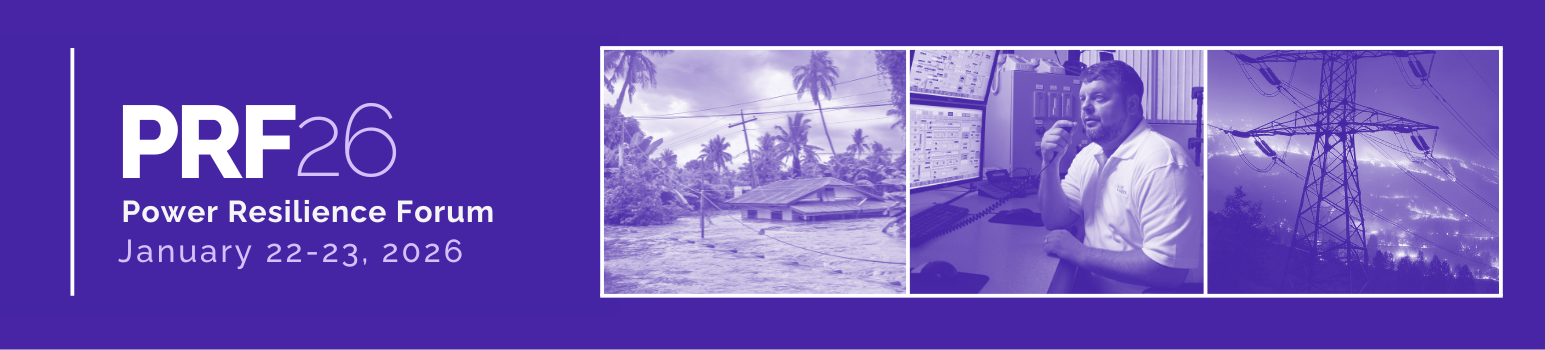
Registration is now open for the 2026 Power Resilience Forum! From January 21-23, PRF will convene experts at the intersection of the power sector and resilience solutions to tackle grid resilience in an era of extreme weather. Register by October 15th for early bird pricing at resilience-forum.com.
News from Our Network
From our clients:
-
California energy consultant E3 found that smart electrical panels, like those made by SPAN, could reduce home electrification costs by 40% to 60% while avoiding expensive utility service upgrades.
-
Rhizome CEO Mishal Thadani joined executives from Resilience Insurance Analytics and Allonnia on Nasdaq TradeTalks to discuss how AI and biotechnology can reduce infrastructure costs and improve resource management.
-
WeaveGrid announced a strategic investment from LG Technology Ventures, adding the LG Group's battery expertise to existing backing from Toyota, Hyundai and Kia as the company expands its platform for integrating electric vehicles with the power grid.
-
Octopus Energy is spinning off its Kraken AI platform as an independent company after reaching $500 million in annual revenue while managing energy for 70 million households worldwide.
-
Treeswift was featured on Bloomberg Tech as Inspired Capital discussed their portfolio of physical AI companies solving infrastructure challenges with intelligent systems.
- Congruent Ventures and Silicon Valley Bank released their 2025 "50 by 2050" list, recognizing companies positioned to significantly advance global decarbonization over the next 25 years, featuring numerous current and past Ad Hoc Group clients among the selected innovators.
From friends and colleagues:
-
Rondo Energy's thermal batteries—bricks that store renewable electricity as 2,000-degree heat—could replace Pueblo, Colorado's coal plant with clean industrial energy, potentially ending decades of respiratory disease from coal pollution.
-
Charm Industrial repurposed an orphaned oil and gas well in Central Louisiana for bio-oil injection, creating over 500,000 tonnes of carbon storage capacity and marking the company's expansion into its fourth U.S. state.
-
On Latitude Media's Open Circuit podcast, PowerLines CEO Charles Hua warned that electricity bills have risen 30% since 2021, becoming a major political issue driven by transmission and distribution spending rather than generation costs.
-
During a United States Energy Association webinar, Ad Hoc Group’s partner Julia Hamm called for a comprehensive national wildfire strategy, arguing that the current state-by-state, utility-by-utility approach fails to address an all-sector societal crisis.
-
ConnectDER launched IslandDER, a meter socket adapter that installs in 15-30 minutes to enable whole-home battery backup without costly panel upgrades.
Jobs in Our Network
Send us your job openings in cleantech policy, startups, and utilities, and we'll put them in next month's Gist.
All Roles:
- WeaveGrid: Head of Go-to-Market (San Francisco, CA or remote)
- Treeswift: Account Executive (New York, NY)
- Span: Director of Utility Business Development (San Francisco, CA)
- CEBA: Director, Transmission Policy (Washington, D.C.)
- Thalo Labs: Director of Software Engineering (New York, NY)
- X, Alphabet’s Moonshot Factory (Tapestry): Public Policy Manager (Mountain View, CA or Washington, D.C.)
- Renew Home: Counsel, Commercial (Remote)
- Consumers Energy: Executive Director of Corporate Strategy (Jackson, MI)
- VEIR: Power Project Manager - Data Centers (Woburn, MA)
- Uplight: Partnerships Manager (United States)
- Distributed Sun: Interconnection & Utility Services Specialist (Washington D.C.)
- California ISO: Manager, Policy Development - Demand Response and Distributed Energy (Folsom, CA or Remote)
- Kraken: Client Delivery Lead - Residential Flex (New York, NY)
- Renew Home: Director, VPP Operations (Remote)
Find Us
- Tess O'Donnell will be at the CEC's EPIC Symposium on Oct. 7 in Sacramento, California.
- Julia Hamm and Max Tuttman will be at the NextGrid Alliance Summit from Oct. 8-9 in Boston, Massachusetts.
- Julia Hamm will be at Quanta's Utility Perspectives Summit from Oct. 19-21 in Colorado Springs, Colorado.
- Katherine Cunningham will be at the EPRI Climate READi Annual Meeting from Oct. 22-23 in Milwaukee, Wisconsin.
- Chandler Mesirov will be at New Dawn by Powerhouse on Oct. 23 in Oakland, California.
- Jim Kapsis will be at Galvanize’s annual summit in San Francisco, California from Oct. 27-28.
- Tess O'Donnell will be at VERGE from Oct. 28-30 in San Jose, California.