

Insights
Learn more about
The Gist
The Gist is the monthly newsletter of The Ad Hoc Group that covers everything at the intersection of climate tech and policy. Subscribe at the link here to have The Gist mailed to your inbox each month.

The Ad Hoc Gist: Beware Climate Tech’s Pits of Despair
In this month’s Gist, my colleague Max Tuttman draws on his Ad Hoc and ARPA-E experience to explain how climate tech startups can avoid falling into some common traps, which he calls the “Pits of Despair.”

The Ad Hoc Gist: Geothermal, It’s So Hot Right Now
Geothermal technology is getting a lot of attention lately. There are essentially two types: geothermal power and geothermal heating and cooling. The former can deliver clean power 24/7, while the latter can heat and cool buildings super efficiently.
We enlisted two experts, Joselyn Lai, CEO of Bedrock Energy, and Michael Campos, investor at Energy Impact Partners, to help us understand the enthusiasm, challenges, and bold predictions for the future of geothermal technologies.

The Ad Hoc Gist: Meet Our New Partner, Julia Hamm
This month, we’re thrilled to announce that longtime senior advisor Julia Hamm is joining the AHG team as our newest partner. Julia brings decades of experience as the former CEO of the Smart Electric Power Alliance (SEPA), founder of RE+ (now the largest energy trade show in North America), and much more.
Read on to learn about Julia’s career highlights, her vision for breaking down barriers between startups and utilities, and life in southwest Florida.
White Papers
The Ad Hoc Group, in partnership with other industry thought leaders, publishes white papers that take a deep dive into the complex issues facing the energy industry and our clients.

Bridging the Load Gap: A Collaborative Path for Utilities, Hyperscalers and Customers
In this white paper, published in January 2026, the Alliance to Save Energy and the Ad Hoc Group explore whether a collaborative model – one in which a large load funds incremental, utility-directed demand-side management (DSM) investments that include both demand response (DR) and energy efficiency (EE) programs – could unlock new capacity, reduce pressure on infrastructure timelines, and support improved affordability and resilience for customers.
Blog
Follow our blog for updates from The Ad Hoc Group.
People as Moat – Ad Hoc Expands into Search
In climate tech, we talk a lot about, well, technology. But talk with most CEOs and they’ll share that the hardest part of their job is figuring out how to hire and retain the right people. In my experience, a company’s ability to hire and effectively onboard the right people is what differentiates successful businesses from those that falter. Because, as a CEO, you can have a great vision, but if you don’t have the right people, you can’t execute it.
Press

What Utilities Learned from Winter Storm Fern
When Winter Storm Fern swept across the United States last month, it served as a stress test for the grid hardening measures that utilities have employed in the last few years. As a large swath of the U.S. froze, there was intense scrutiny of how the grid would hold up.
In Texas, a combination of infrastructure winterization and a diversified grid — including new batteries — allowed ERCOT to hold the line. It was the Southeast that ultimately saw the most outages, due to frozen equipment and iced-over lines.
But the debate over why the grid mostly held continues, with stakeholders tending to view the conversation through the lens of their own resource of choice. Even the U.S. Department of Energy has entered the fray, emphasizing the minimal role of coal in keeping the lights on.
Ad Hoc Group founder and CEO Jim Kapsis joined Latitude Media editor Lisa Martine Jenkins on Latitude Dispatch to dissect the impact of the storm.
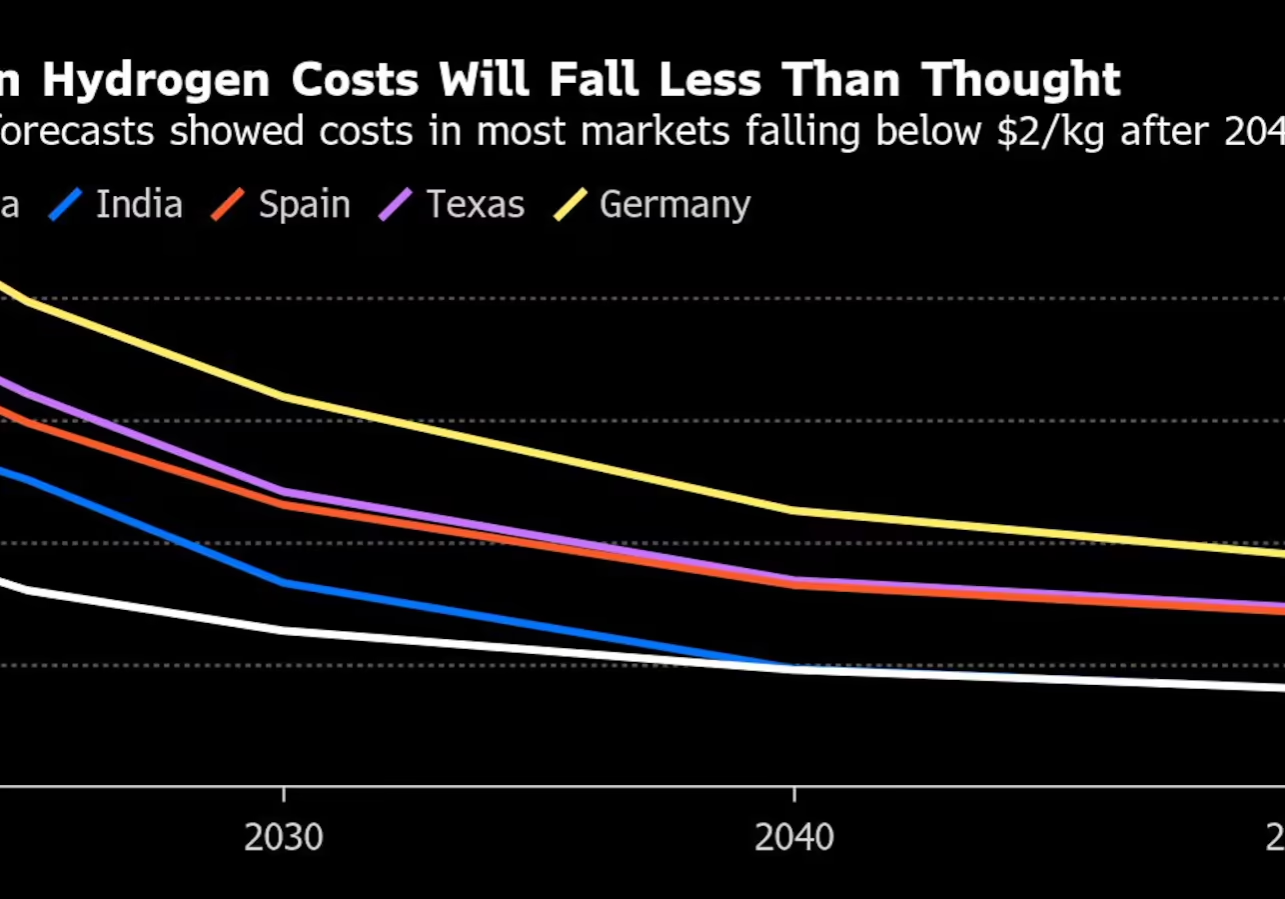
Where the Smart Climate Tech Venture Money Is Going in 2025
This year is shaping up to be a dramatic one for climate tech investors.
Donald Trump’s return to the White House is set to shift the US landscape, with the possible rollback of key provisions in the Inflation Reduction Act, Energy Department loans drying up and weaker regulations. Beyond the US, the prospect of more trade wars is scrambling the economy in ways that will determine which climate tech sectors to bet on.
Meanwhile, headwinds for hydrogen are throwing doubt on its viability, and artificial intelligence is now fully on investors’ radars.

The Regulator’s Dilemma, Part 3
Virtual power plants (VPPs) are poised to revolutionize the power sector by orchestrating distributed energy resources (DERs) — like smart thermostats, household appliances, solar panels, batteries, and electric vehicles — into real-time networks of dispatchable capacity. The opportunity is especially significant for advanced VPPs, which aggregate multiple device types, are fully automated and optimized by price signals, provide multiple reliable grid services, are compensated on a pay-for-performance basis, and serve as a true supply-side resource.
Advanced VPPs can offer grid operators significant value by reducing stress on generation, transmission and distribution infrastructure at lower cost than conventional solutions like large-scale batteries, peaker plants, or additional poles and wires.
Podcast
Hear more from our leadership on industry podcasts.