

Insights
Learn more about
The Gist
The Gist is the monthly newsletter of The Ad Hoc Group that covers everything at the intersection of climate tech and policy. Subscribe at the link here to have The Gist mailed to your inbox each month.
The Ad Hoc Gist: Energy’s post-election to-do list
Elections matter. On the other side, the vibes change. Some doors open while others close. Timing is everything.
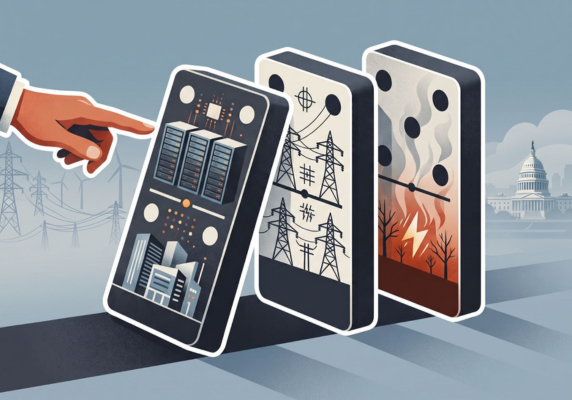
In this month’s Gist, I call out three transformational decisions that could follow in the weeks after votes are cast. They will shape if and how we build and power data centers, whether we can build new transmission infrastructure without politicizing every major power project, and how we’re going to protect communities from wildfire without bankrupting utilities.

The Ad Hoc Gist: The Rise (and Fall) of Distributed Data Centers
The opposition to big data centers transcends party loyalty and raises a new question. Where will all the compute go?
This month’s Gist looks at one emerging answer: putting distributed data centers in underutilized commercial buildings. I argue that utilities and regulators should take action before the market gets too far ahead of them — and that developers should avoid making the same mistake twice.

The Ad Hoc Gist: Carbon Removal Hits the Brakes
Carbon removal is in another difficult cycle. Investment has slowed, policy support in the U.S. has evaporated, and big buyers like Microsoft are reevaluating their commitment.
For this month’s Gist, Ad Hoc’s Max Tuttman spoke with Neil Renninger, a longtime climate-tech entrepreneur and investor to unpack the meaning of this moment. Neil co-founded Amyris and later founded Ample Carbon, which aims to convert retiring coal plants into carbon-negative power facilities, but is now pressing pause.
White Papers
The Ad Hoc Group, in partnership with other industry thought leaders, publishes white papers that take a deep dive into the complex issues facing the energy industry and our clients.
Behavioral Economics and the Human Dimension of Prepaid Utility Service
In this white paper, published in August 2026, Exceleron and the Ad Hoc Group examine prepaid electric service as a mechanism for energy efficiency through the lens of behavioral economics, exploring how it can advance residential affordability and persistent energy conservation at a time of rising electricity costs.
Synthesizing evidence from established U.S. and international programs, we find that prepay implementations have been associated with persistent residential energy savings of roughly 4% to 17%, and we interpret these outcomes through five behavioral principles: customer agency, cognitive bandwidth, loss aversion, price salience, and operant conditioning. Drawing on a detailed case study of the Orlando Utilities Commission’s program, we also explore how modern prepay designs are evolving into human-centered platforms — integrating non-disconnect models, usage disaggregation, and gamification to provide customers with additional agency over their energy usage and improve their utility experience.
Ample Carbon: Lessons Learned From the Shifting U.S. BECCS Landscape from 2023-2026
Ample Carbon was founded in 2023 to convert the U.S. retiring coal fleet into a source of durable carbon dioxide removal (CDR) by retrofitting coal plants into bioenergy with carbon capture and storage (BECCS) facilities. In this white paper, published in August 2026, Ample Carbon and the Ad Hoc Group explore how market conditions have shifted over the past 2-3 years, what Ample has learned, and what the company has built along the way. We categorize the changes across four dimensions: the U.S. power utility landscape, the market for durable carbon removal, the biomass supply chain, and federal policy and funding. We also outline the technical and market progress Ample has made in identifying potential retrofit targets and derisking remaining technical challenges related to feedstock choice.

Bridging the Load Gap: A Collaborative Path for Utilities, Hyperscalers and Customers
In this white paper, published in January 2026, the Alliance to Save Energy and the Ad Hoc Group explore whether a collaborative model – one in which a large load funds incremental, utility-directed demand-side management (DSM) investments that include both demand response (DR) and energy efficiency (EE) programs – could unlock new capacity, reduce pressure on infrastructure timelines, and support improved affordability and resilience for customers.
Blog
Follow our blog for updates from The Ad Hoc Group.
People as Moat – Ad Hoc Expands into Search
In climate tech, we talk a lot about, well, technology. But talk with most CEOs and they’ll share that the hardest part of their job is figuring out how to hire and retain the right people. In my experience, a company’s ability to hire and effectively onboard the right people is what differentiates successful businesses from those that falter. Because, as a CEO, you can have a great vision, but if you don’t have the right people, you can’t execute it.
Press

Is winter coming for climate tech?
We’re worried about climate tech.
We lived through cleantech 1.0 (b. 2007, d. 2011), and we see signs of similar mistakes unfolding this time around. And the problems are not restricted to a single group. Both founders and venture capitalists need to re-think their approach to the market.
On the one hand, founders need to deeply assess the business they’re building, and create a capital plan that fits their model — not every company is built to be a unicorn. On the other, VCs need to re-assess how they partner with startups, and consider paths that involve more ownership and increased operational expertise. For both sides, it’s time to focus on putting points on the board.

Unbound Wildfire Liability is a Cost the US Can’t Afford
Utility wildfire mitigation plans aren’t enough.
“We are all one spark away from bankruptcy,” said one utility CEO at the recent Western Conference of Public Service Commissioners meeting.
He was speaking about wildfires: a topic under regular conversation at energy industry events and in utility board rooms. The business of providing electricity is being turned on its head, and all of us are paying a price….

USEA Power Sector Podcast Episode 27: The Ad Hoc Group Principal Brian Kooiman
In Part 3 of a series on distribution system resources and reliability, The Ad Hoc Group Principal Brian Kooiman answered questions by journalist Herman K. Trabish about the role of demand side flexibility in the U.S. power sector resource mix and reforms are urgently needed from federal and state regulators to allow customer-owned resources to realize their potential to improve electricity delivery reliability, reduce customer bills, and achieve decarbonization goals.
Podcast
Hear more from our leadership on industry podcasts.